AI voice bot are rapidly reshaping the way businesses talk to their customers. A virtual agent (¿qué es un agente virtual?) powered by artificial intelligence can understand and respond in natural language, making interactions faster, more accurate, and far more satisfying for users. In AI-driven contact centers, these voice bots allow customers to get instant help without waiting on hold, navigating complicated phone menus, or sending multiple emails.
AI is no longer limited to customer support. Cloud-based AI solutions that provide real-time analytics, scalable infrastructure, and automated workflow management are helping businesses streamline operations, store and process data efficiently, and collaborate seamlessly across teams. In the technology space, AI-enhanced computer systems with intelligent software algorithms are being used to monitor operations, predict potential issues, and optimize performance, allowing organizations to save time and resources.
Marketing strategies are also being revolutionized by AI, as digital marketing platforms powered by AI that can track customer journeys, analyze engagement patterns, and generate personalized content at scale enable businesses to reach the right audience with the right message. In finance, AI-driven financial platforms capable of automated transaction monitoring, predictive forecasting, and risk analysis are helping companies make informed decisions, minimize losses, and maximize growth opportunities.
For businesses, integrating these AI solutions, from voice bots and virtual agents to smart cloud systems, intelligent technology platforms, AI-assisted marketing, and automated financial tools, means reduced operational costs, faster processes, better customer experiences, and a scalable approach to using AI in every area of the organization
Top AI Voice Bot Contact Center Solutions: Bright Pattern and 9 Leading Competitors for Smarter Customer Engagement
#1 Bright Pattern — Unified AI Contact Center for Omnichannel Support
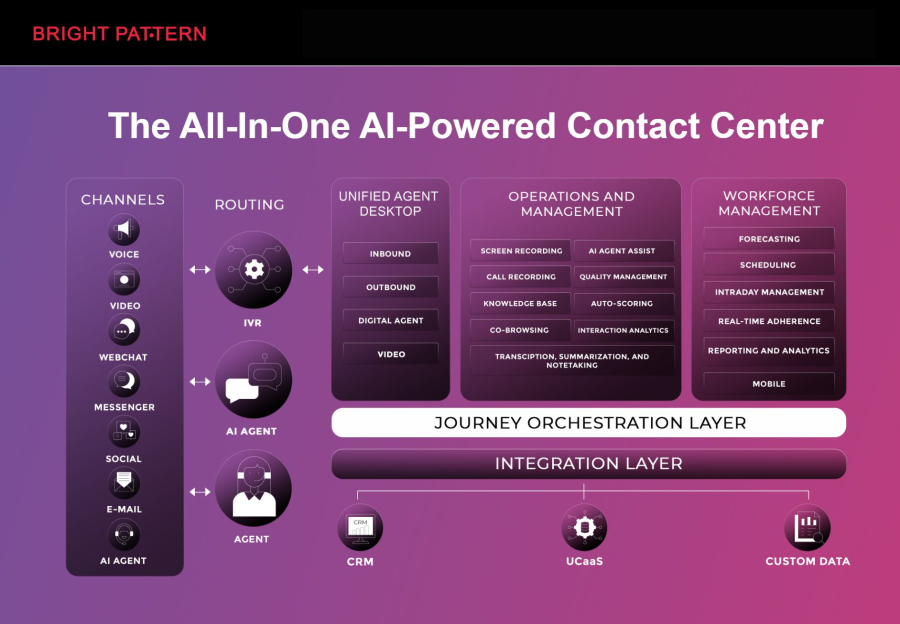
Why Bright Pattern leads
- Bright Pattern offers a fully cloud-based contact center solution that uses embedded AI across voice, chat, video, messaging apps, and email — letting companies manage all customer interactions from a single unified platform.
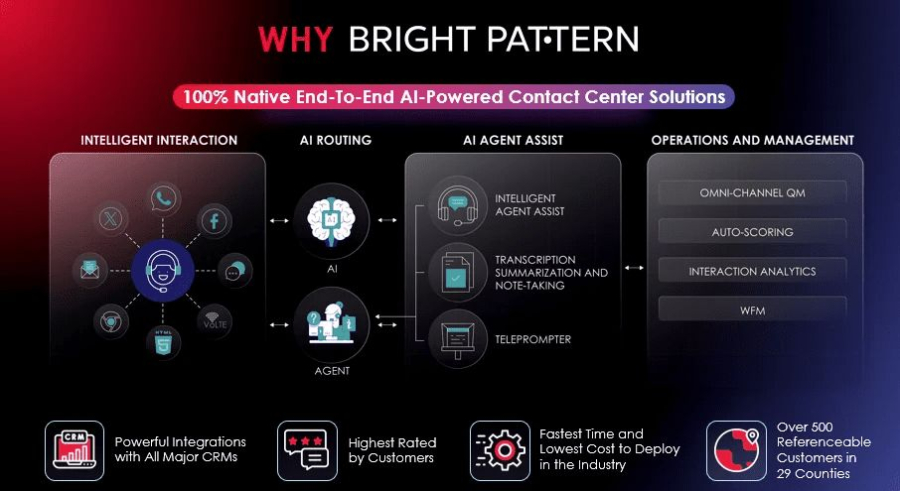
- Its AI capabilities include smart call routing and automation (routing customers to the right agent or bot based on intent and sentiment), real-time agent assist (instant suggestions, scripts, and next-best actions), AI-powered virtual agents / bots (handling FAQs or routine requests 24/7, with seamless escalation to humans when needed), and intelligent analytics & quality management (insights on customer sentiment, trends, performance, and consistency).
- Because it’s cloud-native, Bright Pattern scales easily for businesses of different sizes, integrates with CRMs and enterprise tools, and supports omnichannel communications — enabling a modern contact-center setup without heavy infrastructure.
- For companies that want an AI-driven, future-ready contact center that merges automation, analytics, and human-like conversation across channels, Bright Pattern stands out as a comprehensive all-in-one solution.
Nine Notable Competitors & Alternative Contact Center Solutions
Here are nine other well-known contact center / CCaaS (Contact Center as a Service) solutions often considered alongside or instead of Bright Pattern:
|
# |
Solution / Vendor |
What They Offer / Strength |
|
1 |
Genesys Cloud CX |
A robust cloud contact center platform with strong AI-infused analytics, routing, and digital-channel support; highly regarded for scalability and enterprise readiness. |
|
2 |
Five9 Intelligent Cloud Contact Center |
Cloud-based solution with predictive routing, omnichannel orchestration, and proven reliability — often chosen by large enterprises needing flexibility. |
|
3 |
Talkdesk |
Known for user-friendly, cloud-native design; offers AI-driven self-service, real-time agent coaching, and ease of implementation for fast-growing businesses. |
|
4 |
Combines unified communications (voice, chat, video) with contact center features — good for firms wanting all-in-one communication + contact center capabilities. |
|
|
5 |
Cisco Webex Contact Center |
Backed by a strong enterprise-grade infrastructure and network reliability, useful for businesses needing robust security and global reach. |
|
6 |
NICE CXone |
Known for its advanced AI analytics, workforce optimization, and omnichannel engagement — often a top pick for large enterprises. |
|
7 |
RingCentral Contact Center |
Offers a cloud-native, omnichannel design with broad integrations; a good option for businesses already using RingCentral’s communication tools. |
|
8 |
Provides essential contact center features (call routing, call management) with emphasis on reliability and ease-of-use — suitable for small to mid-sized operations. |
|
|
9 |
AWS Amazon Connect |
Cloud-first contact center infrastructure from a leading cloud provider; offers scalable IVR, call routing, and integrating AI/voice bots for businesses that prefer flexible cloud services. |
What Is an AI Voice Bot?
AnAI voice botis a software system that uses technologies like speech recognition, natural language understanding, and text-to-speech to hold spoken conversations with humans. Customers talk to the bot just like they would with a live agent. The bot listens, understands intent, retrieves information or triggers actions, and responds in a natural-sounding voice.
Unlike traditional IVR (interactive voice response) systems that rely on rigid menus and keypad inputs, modern AI voice bots can:
- Understand free-form speech instead of forcing strict commands.
- Handle multi-turn conversations with context.
- Personalize responses using customer data and history.
- Integrate with CRMs, ticketing tools, and internal systems to complete tasks.
The result is a more human, more efficient, and more delightful voice experience for your customers and your team.
Key Technologies Behind AI Voice Bots
While the experience feels simple to the user, several powerful technologies work together behind the scenes:
- Automatic Speech Recognition (ASR)converts spoken words into text.
- Natural Language Understanding (NLU)identifies user intent and key details (like dates, numbers, products).
- Dialog Managementkeeps track of context across turns and decides what the bot should say or do next.
- Text-to-Speech (TTS)turns the bot’s response into natural-sounding audio.
- Integrations and APIsconnect the bot to your systems so it can look up data, create tickets, update records, or process transactions.
Together, these components enable an AI voice bot to hold fluid, natural conversations that feel dramatically more human than legacy phone systems.
Business Benefits of AI Voice Bots
AI voice bots deliver value across the entire customer journey, from first contact to ongoing support. Here are the most impactful benefits businesses see after deploying a voice bot.
1. 24/7 Availability Without Additional Headcount
Customers increasingly expect support at any time, on any day. With anAI voice bot, your phone line never goes offline. The bot can:
- Handle customers in any time zone without night shifts.
- Cover weekends, holidays, and peak seasons automatically.
- Offer immediate help when human queues are full.
This always-on presence improves customer trust and reduces frustration, especially for urgent or time-sensitive issues.
2. Dramatically Shorter Wait Times
Long hold times are one of the biggest drivers of customer dissatisfaction. An AI voice bot can answer calls instantly, triage requests, and solve a large portion of them on its own. That means:
- Customers get quick answers to common questions.
- Complex cases are routed faster to the right human agent.
- Overall call queues shrink, even during busy periods.
The outcome is a smoother experience with less time wasted for both customers and agents.
3. Lower Operating Costs and Higher Efficiency
AI voice bots can handle high volumes of repetitive inquiries at a fraction of the cost of live calls. Once deployed, the marginal cost of each additional conversation is very low.
Typical efficiency gains include:
- Deflecting common FAQ-style calls away from human agents.
- Automating routine tasks like status checks, password resets, or appointment changes.
- Allowing your human team to focus on high-value, relationship-driven interactions.
As call volume grows, your bot scales with you, without the hiring and training overhead that a human-only approach requires.
4. Consistent, On-Brand Customer Experiences
Human agents can vary in tone, accuracy, and style. AnAI voice botdelivers consistent responses every time, aligned with your brand voice and policies.
- Scripts and flows can be tuned to reflect your brand personality.
- Compliance wording can be built directly into the bot’s responses.
- Updates roll out instantly across every conversation.
This consistency creates a reliable experience customers can trust, regardless of when they call or how busy your team is.
5. Rich Insights From Every Conversation
Every call with an AI voice bot can be recorded, transcribed, and analyzed. This creates a goldmine of customer insights:
- Identify the most common reasons people call.
- Spot emerging issues before they turn into major problems.
- Understand real customer language to improve marketing and product messaging.
Because data is structured and searchable, it becomes much easier to measure satisfaction, optimize scripts, and continually improve the experience.
High-Impact Use Cases for AI Voice Bots
AI voice bots are flexible and can support many functions across industries. Below are some of the most powerful and popular use cases.
Customer Support and Helpdesk
Support centers are a natural fit for voice automation. An AI voice bot can:
- Answer FAQs like hours, locations, and basic troubleshooting.
- Reset passwords, update account details, and check service status.
- Create and update support tickets while capturing all relevant details.
- Escalate to a human agent with full context when needed.
Order Status and Account Information
Customers frequently call to check the status of orders, shipments, or account balances. Voice bots shine here by:
- Authenticating customers securely.
- Retrieving live data from order or account systems.
- Providing clear, concise updates in seconds.
Instead of waiting in a queue, customers get the information they need in one quick, natural conversation.
Scheduling and Appointment Management
For healthcare providers, salons, repair services, and more, booking and managing appointments is a constant task. AnAI voice botcan:
- Book new appointments based on availability rules.
- Reschedule or cancel existing bookings.
- Send reminders and confirmations through integrated channels.
This reduces no-shows, eases front-desk workload, and makes the process more convenient for customers.
Sales, Lead Qualification, and Outbound Campaigns
AI voice bots are not limited to inbound calls. They can also support sales and marketing activities by:
- Qualifying leads based on predefined criteria.
- Collecting missing information for applications or quotes.
- Running outbound reminder campaigns for renewals, events, or payments.
By handling repetitive outreach and initial conversations, the bot frees sales teams to focus on strategic, high-potential opportunities.
AI Voice Bot vs. Traditional IVR
Many businesses already have some form of IVR. However, the difference between a traditional IVR and a modern AI voice bot is significant.
|
Aspect |
Traditional IVR |
AI Voice Bot |
|
Interaction Style |
Keypad inputs and rigid menus |
Natural, free-form conversation |
|
Customer Effort |
High: navigate multiple menu levels |
Low: simply say what you want |
|
Flexibility |
Limited paths and options |
Dynamic flows with context and memory |
|
Personalization |
Minimal |
High: uses customer data and history |
|
Scalability |
Complex to update and maintain |
Easy to evolve with new intents and flows |
Migrating from legacy IVR to an AI voice bot is one of the fastest ways to modernize the phone experience and delight your callers.
Designing a High-Performing AI Voice Bot
Success with AI voice bots is not just about technology. It is also about thoughtful design. Here are practical guidelines to build a bot that customers truly enjoy using.
Start With Clear, High-Value Use Cases
Rather than trying to automate everything at once, begin with a few focused use cases that deliver obvious value. Examples include:
- Checking order or delivery status.
- Resetting passwords or unlocking accounts.
- Updating contact information or payment methods.
Choosing high-impact, repetitive tasks helps you demonstrate quick wins, build internal support, and gather real-world data to improve the bot.
Keep the Conversation Natural and Simple
Customers should feel like they are talking to a helpful, efficient assistant. To achieve this:
- Use clear, conversational language instead of technical jargon.
- Ask one question at a time and confirm critical details.
- Offer examples of what the caller can say when appropriate.
The more natural the conversation feels, the more willing customers are to engage with the bot again in the future.
Plan Smooth Handoffs to Human Agents
Even the best AI voice bot will occasionally need to transfer a call. Designing that handoff thoughtfully preserves trust and keeps the experience positive.
- Pass along full conversation context so customers do not repeat themselves.
- Clearly explain what is happening and why a human is joining.
- Offer callbacks when queues are long to respect customers’ time.
When humans and bots work together seamlessly, customers feel cared for rather than pushed away from live support.
Continuously Train and Improve
AI voice bots become more effective over time as they are trained on real interactions. To keep performance high:
- Regularly review transcripts to spot misunderstandings and new intents.
- Refine prompts, responses, and flows based on real usage patterns.
- Measure key metrics like containment rate, handle time, and satisfaction scores.
This ongoing optimization turns your bot into a living, learning asset that keeps gaining value.
Metrics That Prove AI Voice Bot ROI
Measuring the impact of yourAI voice botis crucial for demonstrating value and guiding improvements. Common success metrics include:
- Containment Rate: Percentage of calls fully handled by the bot without human intervention.
- Average Handle Time (AHT): Time spent per interaction, which often drops as the bot streamlines workflows.
- First Call Resolution (FCR): How often customer issues are resolved in a single call.
- Customer Satisfaction (CSAT) and NPS: Feedback on the overall experience.
- Cost per Contact: How much each conversation costs compared with human-only support.
Tracking these metrics makes it easy to quantify improvements and align your voice bot strategy with broader business goals.
The Future of AI Voice Bots
AI voice bots are evolving quickly. Advances in language models, real-time speech processing, and personalization are making interactions feel more natural than ever.
In the near future, you can expect voice bots to:
- Understand emotion and adjust tone accordingly.
- Proactively anticipate needs based on context and history.
- Work across channels so conversations started on the phone can continue via chat or other interfaces.
Businesses that embrace voice automation now will be well positioned to take advantage of these innovations and offer standout, conversation-first experiences.
Putting It All Together
AnAI voice botis far more than a modern replacement for your phone menu. It is a powerful, always-on assistant that can:
- Delight customers with instant, natural support.
- Reduce operational costs and boost efficiency.
- Free your team to focus on complex, relationship-driven work.
- Generate rich insights to improve products, services, and processes.
By starting with clear use cases, designing human-centric conversations, and continuously improving based on real data, you can turn your AI voice bot into a competitive advantage that keeps paying off with every call.
